
7,258,491 hotelsin 60 categories

Sofia rewards travellers who look down as much as up. Beneath the central metro station, the streets of Roman Serdica lie open to the air, brought back to the surface when the line was dug between 2010 and 2012. A few minutes' walk away a fourth-century rotunda of red Roman brick still stands in a quiet courtyard, and over the rooftops rise the gold domes of one of the largest Eastern Orthodox cathedrals in the world. People have lived on this spot for at least seven thousand years, and the city wears its Roman, Ottoman, Orthodox and communist layers all at once, while the ski runs of a 2,290-metre mountain close off the end of almost every street.
We at Travelmyth, the hotel search engine that ranks stays by your interests and needs across 60 stay categories, have put together this guide to what is worth your time in Bulgaria's most underrated capital. It runs from the obvious, like the Alexander Nevsky Cathedral and the Roman ruins under the streets, to the easily missed: a 1980s communist flat preserved room by room, and a square where a mosque, a synagogue and two churches stand within sight of one another. It ends with the day trips that pull most travellers out of the city, a UNESCO monastery up in the mountains among them.

The cathedral in every photograph of Sofia is, in effect, a thank-you note in stone. It was built in honour of the Russian soldiers who died in the Russo-Turkish War of 1877-1878, the war that ended Ottoman rule in Bulgaria. The foundation stone was laid in 1882, most of the work was done between 1904 and 1912, and the finished building was consecrated in 1924. The architect, Alexander Pomerantsev, worked in the Neo-Byzantine style: a cross-domed basilica of pale stone, its central dome plated in gold and rising 45 metres, with a bell tower of 53 metres alongside. Inside, it covers 3,170 square metres and can hold around 10,000 worshippers.
It is often called the largest Orthodox church in the world, which is not quite right: it is one of the largest Christian churches by volume anywhere, and one of the largest Eastern Orthodox cathedrals in the world, which is remarkable enough. It takes its name from Alexander Nevsky, the thirteenth-century Russian prince. Down in the crypt, a museum holds a collection of Orthodox icons. Entry to the cathedral itself is free; there is a separate charge if you want to photograph the interior, so check the current rate at the door.


Sofia's oldest layer is its newest attraction. When the metro was extended between 2010 and 2012, the digging uncovered the heart of Roman Serdica, and rather than build over it the city left it open: a sunken quarter of paved streets, an early Christian basilica, baths and the foundations of houses, spanning the fourth to the sixth centuries AD, free to walk through beside the Serdika station. The Romans had taken the town around 29 BC from a Celtic tribe, the Serdi, who gave it its name. It grew important enough that the emperor Constantine the Great is said to have called it "Serdica is my Rome".
Directly above the ruins stands the Largo, a monument of an entirely different kind: a U-shaped ensemble of severe, symmetrical government buildings thrown up in the 1950s in the Stalinist style, with the former Communist Party House at its head. On the square in front, a statue of Sveta Sofia, the city's namesake, was raised on a column in 2000 on the spot where a statue of Lenin had stood until the end of communism. She holds an owl for wisdom and a laurel wreath.


Tucked into a courtyard between a hotel and the President's offices, a few metres below the modern pavement, sits the oldest building in Sofia. The Church of St George is a rotunda of red Roman brick, built in the early fourth century as part of a larger Roman complex and later turned into a church. It is a simple cylinder under a dome 13.7 metres high, but its walls carry five overlapping layers of fresco: the oldest Roman-Byzantine work from the fourth century, medieval Bulgarian angels from the tenth, later medieval saints, and finally a layer of Islamic ornament. A ring of twenty-two prophets, each over two metres tall, looks down from the dome.

A short walk east, beside the Alexander Nevsky Cathedral, stands a plainer and far older church that most travellers walk straight past, yet it is the one the whole city is named after. The basilica of Saint Sofia goes back to the fourth to sixth centuries, most likely built during the reign of the Byzantine emperor Justinian. For a long time it was simply the principal church of the town then called Serdica; at some point in the fourteenth century the town took the church's name instead, and has been Sofia ever since. The dedication is not to a saint named Sofia but to Holy Wisdom, sophia in Greek. The grave of Ivan Vazov, Bulgaria's national writer, lies under a tree beside it.


On the central square that has been the heart of the city since Roman times stands Sveta Nedelya, a domed cathedral with a quiet, dramatic past. A church has stood here since the tenth century; the present building was rebuilt in the nineteenth, between 1856 and 1863. In 1925 the communist underground attacked the cathedral with explosives, in an attempt to kill senior members of Bulgaria's political and military establishment. More than 200 people were killed and around 500 were injured, in one of the deadliest attacks in the country's history. The cathedral was restored once more, and the dome you see today dates from that rebuilding.

Within a few hundred metres of one another in the centre stand an Eastern Orthodox church, a Catholic cathedral, a mosque and a synagogue, a cluster Sofia likes to call its Square of Religious Tolerance. The mosque is the Banya Bashi, built in the sixteenth century by Mimar Sinan, the great Ottoman architect, and the only working mosque left in the city. Its name means "many baths": it stands over the same thermal springs that fed the public baths next door.
A block away, the Sofia Synagogue was completed in 1909 in an ornate Moorish-Revival style. It is the largest synagogue in the Balkans and one of the largest in Europe, lit by a great chandelier made in Vienna. It also keeps one of the better stories of the Second World War: nearly 50,000 Jews living within Bulgaria's pre-war borders escaped deportation after opposition from politicians, church leaders and members of the public, with the politician Dimitar Peshev among the central figures, although more than 11,000 Jews from Bulgarian-occupied Thrace, Macedonia and Pirot were deported and killed. The fourth corner of the square is St Joseph's, the Catholic cathedral, rebuilt in 2006 after the original was destroyed in the 1944 bombing of Sofia.

The grand yellow-and-red building beside the mosque looks like a cathedral and was, for most of the twentieth century, a bathhouse. The Central Mineral Baths opened in 1913 and served as the city's public baths until 1986; after a long restoration they reopened in 2015 as the Sofia History Museum, which tells the city's story from Roman Serdica onward. You do not have to go in to feel the point of the place. Sofia sits on a field of warm mineral springs, and rows of public taps in the forecourt still run with free, faintly warm mineral water that locals come to fill bottles from.

Sofia's prettiest church is the smallest of its famous ones. The Russian Church of St Nicholas, built between 1907 and 1914 as the church of the Russian embassy, is a jewel box of five gold-tipped domes, named for the patron saint of the last Russian tsar. Down in its crypt lie the relics of Archbishop Seraphim, and the crypt is a popular place of pilgrimage, a working shrine rather than a museum piece.

The grandest piece of theatre in Sofia is the theatre itself. The Ivan Vazov National Theatre, Bulgaria's oldest, was built to the design of the Viennese architects Fellner and Helmer and opened in 1907, a Neoclassical front of columns with gilded ornament and statues of Apollo. It faces the City Garden, the oldest public garden in the city, laid out in 1872 and a favourite spot for locals to sit out the afternoon. The two together make the easiest place in the centre to watch the city go by.


Sofia spent the second half of the twentieth century behind the Iron Curtain, and it has learned to show that history rather than hide it. The most vivid way in is the Red Flat, an interactive experience presenting the home of an average Bulgarian family in the 1980s, which you explore on your own. For the wider picture, the Museum of Socialist Art gathers statues and paintings from the communist period, offering a chance, as one guide puts it, to come face to face with the impact communism had on Bulgaria.
Out in the open, the legacy is patchier. The Monument to the Soviet Army, erected in 1954 to commemorate the Soviet Army, became briefly famous in 2011 when activists painted its bronze figures as Superman, Wonder Woman, Santa Claus and Ronald McDonald. Its principal sculptural groups were dismantled from December 2023, and the location is now commonly referred to as the site of the former Monument to the Soviet Army.

If the weather turns, Sofia has the museums to fill a day. The National Museum of History, the largest in Bulgaria, sits a little out of the centre in the Boyana district, in a vast former residence of the communist leader Todor Zhivkov; among its most famous holdings is the Panagyurishte Treasure, a set of Thracian gold vessels. In the centre, the National Gallery occupies the former Royal Palace, and the National Archaeological Museum fills the former Buyuk, or Great, Mosque, a fifteenth-century Ottoman building that has housed the museum since its establishment in the 1890s. Between them they cover everything from Thracian gold to twentieth-century Bulgarian painting.

On the southern edge of the city, where the streets give out at the foot of Vitosha, a small stone church holds some of the most important medieval painting in the Balkans. Boyana Church was added to the UNESCO World Heritage List in 1979, and the reason is a single layer of frescoes painted in 1259: scenes of unusual realism and feeling for their date, among them a famous pair of portraits of the nobleman who paid for the work, Sebastocrator Kaloyan, and his wife Desislava. The church itself grew in three stages between the eleventh and the nineteenth centuries. It is tiny, and it sits a few minutes from the National Museum of History, so the two make a natural half-day together.


Few European capitals have a mountain as prominent and accessible as Vitosha immediately beside the city, and on a clear day it fills the end of half of Sofia's streets. Its summit, Cherni Vrah, the Black Peak, reaches 2,290 metres; the whole massif was protected in 1934 as the oldest nature park in the Balkans.
It is the city's closest ground for hiking and skiing, easily reached by bus or car; in winter it is Sofia's ski hill, while the rest of the year it is its nearest mountain walk.
Three things in particular reward the trip up. The Boyana Waterfall drops about 25 metres through the forest above the Boyana quarter. The Golden Bridges are a spectacular "stone river" of huge boulders formed through weathering and periglacial processes during colder periods, about 16 kilometres from the centre. The medieval Dragalevtsi Monastery clings to the lower slopes, part of a ring of small monasteries once known as Sofia's Holy Mountain.


Back in the centre, Vitosha Boulevard, known locally as Vitoshka, is the main pedestrian street, running south through the city centre towards the mountain that gives it its name and frames the view at its end. It is a place for a coffee and people-watching more than for sights. For something earthier, two markets are worth the short detour: the Women's Market, the oldest open-air market in Sofia, a long run of fruit, cheese and spice stalls; and the Central Market Hall, a handsome covered hall from 1911 in a mix of Neo-Renaissance and Art Nouveau, restored and reopened in 2024 as a modern retail space within the historic building.


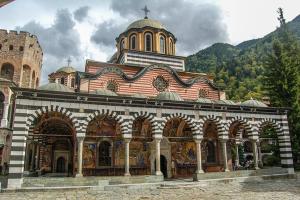
Two of Bulgaria's biggest sights are day trips from Sofia, and both are worth giving up a city day for. Rila Monastery, 117 kilometres south in the Rila mountains at 1,147 metres, is the largest and most revered Orthodox monastery in the country: high stone walls that make the outside look more like a fortress than a monastery, a courtyard of striped, arcaded galleries within, and a richly frescoed nineteenth-century church at its centre. It was founded in the tenth century and named after the hermit Saint Ivan of Rila, and has been a UNESCO World Heritage Site since 1983. Higher in the same range, the Seven Rila Lakes are a chain of glacial lakes reached by chairlift and a few hours' walking, a full day and best in summer.
In the other direction lies Plovdiv, one of Bulgaria's biggest and oldest cities, about two and a half hours east by train: a Roman theatre from the second century AD that still stages concerts, a hilltop old town of painted merchant houses, and a centre that was a European Capital of Culture in 2019. Each of these really deserves a guide of its own, and will get one; here they are simply the reasons to give Sofia three days rather than two.

Getting in is easy: Sofia Airport sits on the metro, and the train to Serdika station, in the thick of the central sights, takes roughly 20 to 25 minutes. Around town, public transport is inexpensive and simple, though most of the sights in this guide are an easy walk from one another.
A good way to get your bearings on the first morning is the free walking tour, which runs several times a day, all year round, from in front of the Palace of Justice.
One practical point: Bulgaria uses the euro, which replaced the lev on 1 January 2026. The word lev means "lion" in old Bulgarian. Spring and autumn are the kindest seasons for a city break; come in winter and you can pair the museums with a morning on the Vitosha ski slopes.

Most of the sights in this guide are packed into a walkable centre, so a central base is worth more than almost anything else. Travelmyth lists thousands of stays in Sofia and ranks them by what you actually care about, whether that is a boutique-style place near the old town or a family-friendly base. You can also combine any two filters to narrow the list.